GRADUATE PROGRAM IN GEOSCIENCES (M.S., Ph.D.)
FACULTY
PROFESSORS:
Carlos L. V. Aiken, David E. Dunn, Anton L. Hales
(emeritus), Mark Landisman, William I. Manton, George A. McMechan,
Richard M. Mitterer, Kent C. Nielsen, Emile A. Pessagno, Jr., Dean C.
Presnall, Robert H. Rutford, Robert J. Stern
ASSOCIATE PROFESSORS:
James L. Carter, John F. Ferguson, Kristian
Soegaard
ASSISTANT PROFESSOR:
Scott J. Carpenter
OBJECTIVES
The basic objective of the Graduate Program in Geosciences is to
providestudents with a broad fundamental background in all aspects of
geosciences as well as with an in-depth emphasis in a particular
specialty.
The Master of Science degree is designed for students who seek
employment opportunities in the energy, environmental or mining
professions in industry or government or in the teaching profession,
and for those seeking a doctoral degree.
The Doctor of Philosophy degree emphasizes basic research in one of
the specialties in geosciences and is designed to prepare students for
advanced positions in the energy, environmental or mining professions
in industry or government, or for positions in academia.
In general, entering students intending to pursue a geology emphasis
are expected to have completed the equivalent of the university's B.S.
degree in Geosciences (geology or geophysics options). Students whose
undergraduate training is in a science other than geology are admitted
to the program when their previous course work complements or supports
their research interests.
All entering students with non-geoscience degrees such as physics,
math, chemistry or biology should have completed physical geology,
rocks and minerals, structural geology, and sedimentology. All
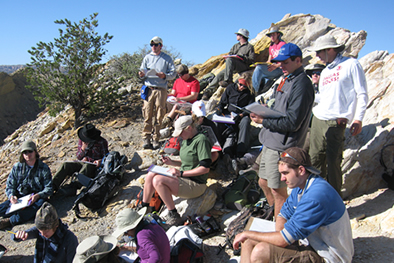
students are expected to have completed a faculty approved summer
field camp.
Students may be admitted with some deficiencies but these must be
completed before the qualifying examination. It is understood that the
minimum course requirements for the intended degree, as specified
below, apply to well-preparedstudents.
SPECIFIC DEGREE REQUIREMENTS
- M.S. (42 hours minimum)
- Ph.D. (90 hours minimum)
MASTER OF SCIENCE
All students seeking the Master of Science degree in Geosciences must
satisfactorily complete the following requirements (minimum of 42
graduate semester hours).
- Complete GEOS 5303 (unless an acceptable 3-hour scientific
programming course is presented upon initial enrollment), GEOS 5304
(or acceptable equivalent), and GEOS 6215.
- Complete a minimum of four courses (minimum of 12 semester hours) in
a chosen specialization related to the student's major area of study.
Specialty areas are: geochemistry, geophysics, mineral
resources-petrology, paleontology, sedimentology, seismology,
stratigraphy, and structural geology-tectonics.
- Complete a minimum of three courses (minimum nine semester hours) in
at least two specialties other than the chosen specialization.
- Complete a minimum of nine semester hours of thesis research plus
GEOS 8398 and submit an acceptable thesis.
In addition to the above requirements, students seeking the M.S.
degree must submit no later than the second semester of enrollment an
acceptable research proposal to the supervising committee. Upon
completion of the thesis research, the M.S. degree candidate will
publicly defend the thesis.
DOCTOR OF PHILOSOPHY
All students seeking a Doctor of Philosophy degree in Geosciences must
satisfactorily complete the following requirements (90 semester hours
minimum).
- Complete GEOS 5303 (unless an acceptable 3-hour scientific
programming course is presented upon initial enrollment), GEOS 5304
(or acceptable equivalent), and GEOS 6215.
- Complete a minimum of five courses (minimum 15 semester hours) in a
chosen specialization, related to the student's major area of study,
selected from the specialties listed under the Master of Science
requirements.
- Complete a minimum of five courses (minimum 15 semester hours) in at
least three specialties other than the chosen specialization. A Ph.D.
candidate already holding a Master's degree in Geosciences may
satisfy, with approval of faculty, two of these five courses via
previous graduate work.
In addition to the above course requirements, students seeking the
Ph.D. degree must submit no later than the fourth semester in
residence an acceptable research proposal describing the intended
project to be completed for the dissertation. An oral qualifying
examination, covering the broad background and detailed knowledge
relating to the student's specialization and research proposal, will
be held during the fourth semester. After satisfactory performance on
the Qualifying Examination, the student will complete and publicly
defend the dissertation.
For general degree requirements, see General Academic Regulations.
FACILITIES
Research facilities include: Scintag XDS-2000 automated x-ray
diffractometer, Perkin Elmer atomic absorption spectrophotometer with
graphite furnace, Perkin Elmer Plasma II Emission spectrometer
(Inductively Coupled Plasma-Atomic Emission Spectrometer), JEOL
JXA-8600 automated electron microprobe with energy dispersive
spectrometers, JEOL JSM-T300 scanning electron microscope, Nuclide
ELM-2B luminoscope with a Nikon Optiphot equipped with an automated
photographic system, two research quality zeiss epi-fluorescence
reflected light microscopes with a fluid inclusion stage and video
monitor, photometer-indicator and an automated photographic system,
petrographic microscopes, rock preparation facilities, and machine
shop. Network access to the University IBM 4381, N-Cube, Convex
computers, two Silicon Graphics workstations, and the Cray YMP at the
UT-System Center for High Performance Computing is available.
EXPERIMENTAL PETROLOGY LABORATORY
The laboratory contains four piston-cylinder presses and two
multianvil presses for experiments form 7 to 250 kbar at temperatures
up to 2500o C. Also, furnaces are available for studies at 1
atmosphere at temperatures up to 1600o C under controlled oxygen
fugacities. These facilities, together with the JEOL 8600 electron
microprobe, allow a wide range of phase equilibrium studies bearing on
the generation and crystallization of magmas and the primitive Earth's
fractionation from deep magma oceans into crust, mantle and core.
ROCK DEFORMATION LABORATORY
This laboratory houses a solid media Griggs-type press for experiments
up to 2GPa and 1200o C, a large liquid confining medium press for
controlled pore pressure, low temperature test up to 200 MPa confining
pressure, and an INSTRON materials testing system (Model 1127). These
instruments provide a range of deformational environments equivalent
to a transect through the lithosphere, including the brittle ductile
transition in most silicates.
ORGANIC GEOCHEMISTRY LABORATORY
Carlo Erba CNS elemental analyzer, two Tremetrics gas chromatographic
systems, HP 5880 gas chromatograph and a St. John amino acid analyzer.
THERMAL IONIZATION MASS LABORATORIES
Four thermal ionization mass spectrometers (TIMS), including a
Finnigan-MAT 261 mass spectrometer, are housed in two laboratories.
These instruments are used to determine the isotopic composition of
Sr, Nd, and Pb, as well as the concentration of K, Rb, Sr, Ba, REE,
Pb, Th, and U in natural samples. Studies focus on determining the
isotopic composition of Sr in carbonate rocks, the age of igneous
rocks and minerals, the source of basaltic and granitic magmas and ore
deposits and the cycling of Pb in the environment. Samples are
prepared in two clean chemical laboratories.
STABLE ISOTOPE LABORATORY
This laboratory houses a Finnigan delta-E gas ratio mass spectrometer
with an automated microvolume and on-line carbonate reaction system,
high-vacuum extraction lines for preparation of a variety of gases,
micro-sampling apparatus, and wet-chemistry facilities for minor
element and strontium isotope sample preparation carbonates.
Geophysical research is supported by LaCoste-Romberg Model G
gravimeter, Nikon theodolite and data collector, Zeiss Total Station
electronic distance meter and theodolite, two 16 channel 4000 SST
Trimble dual frequency geodetic and one dual channel Trimble
Pathfinder II professional and one 3-channel Trimble Basic Global
Positioning System (GPS) receivers with accessories for static and
kenematic surveys, an array of recording three-component magnetic
variometers, a multiuser virtual memory vector computer system (Convex
C-2) with 256 MB of real memory, 20 GB of disk and a full complement
of peripheral devices including monochrome and color plotting,
numerous workstations (Sun) and an INTEL iPSC860; a 24-channel
floating point seismic acquisition system with Betsy, Dinoseis and
explosive sources for shallow to deep exploration; two Geometrics G806
magnetometers; 3 ABEM recording and mobile magnetometers, one Bison
susceptibility bridge, a VLF-EM meter; several IBM compatible PCs
including one with a 48 inch GTCO digitizing table, a microfilm
library of WWSSN records; pulse EKKO IV and 100 ground penetrating
radar systems; and Bison 9000 seismographs. There are extensive GIS
(Geographic Information Systems) facilities including CARIS (Computer
Assisted Resource Information System) and ARC/INFO GIS software
packages with graphical hardware.
GEOSCIENCES COURSE DESCRIPTIONS
BACK TO TABLE OF CONTENTS