I'm a Professor of
Instruction in the Computer Science
Department here at
the University of Texas at Dallas. I taught
part-time at Collin County Community
College for three years, and prior to that, at Illinois Institute of
Technology in the mid-1970s, which is also where I earned my degrees.
Before joining the full-time faculty at UTD in Fall 2012, I had taught part-time for 13
semesters. I have been a software developer for many years, working
on projects as diverse as a SNOBOL4 compiler, a
DATABUS compiler, a word
processor, the operating system for an early computer, statistical
analysis of insurance claims, telecommunications, and embedded programming.
Essentially, I would write anything for which someone would sign a check. I have used a variety of
languages, including Java, C/C++, C#, Visual Basic, Databus, FORTRAN, Intel assembly language,
and many others. I still do some outside programming. Note
to graduate students: I am not a researcher nor can I give you an
assistantship of any sort.
Welcome to The University of Texas at Dallas
Office Hours for
Spring Semester 2024 in ECSS 4.606. In person only.
Monday from 2:30 to 3:30 PM (After CS2340 class) Tuesday: 11:00 AM until
noon Wednesday from 11:30 AM to 12:30 PM (Before CS2340 class) Office hours tend to be busy, so I must give priority to current
students. However, anyone, from former students and other faculty to lost
souls needing insecticide, is welcome to visit.
Office: ECSS 4.606. Phone: 972/883-6353 E-mail me at John.Cole@utdallas.eduPlease use this instead of eLearning for
correspondence. Students, if this concerns a class, please include
which class and section you're taking in the subject line or I may not answer. Do not
e-mail me code to "have a look at and let me know if there are problems."
Come to office hours. I don't answer these. I don't always answer
e-mail after 8:00 PM, and rarely on Sundays. I rarely answer Teams texts that
are not in a class,
especially when they are requests for information you can find on my Web page or
in the course syllabus. If you're asking for a recommendation, remind me which
classes you took from me and when. I teach hundreds of students every
year, and unless you sat near the front and participated, or came to office
hours frequently, I may not remember you very well. I always go back to
the work you turned in as part of being able to write a good recommendation.
Make sure it is good work and yours.
I'm the faculty sponsor
for the student chapter of the ACM at UTD. Check their Web site for
information on events. I'm also the faculty Advisor for
Nebula Labs, a programming group
creating tools to help students at UTD.
As of August 1, 2021, I'm the Executive Director of the
Executive Master's in Software Engineering
(EMSE) program. This is for working professionals who want to get an
advanced degree by going to school part-time. I love to tinker with embedded programs, the
Raspberry Pi, Arduino, and of course write little Android apps.
From Cal Newport's book Deep Work: The Deep Work Hypothesis:The ability to perform deep work is
becoming increasingly rare at exactly the same time that it is
becoming increasingly valuable in our economy. As a
consequence, the few who cultivate this skill and then make it the
core of their working life will thrive.
3/19/2022
Use of GitHub. Some students use this for
programming assignments, which is fine if it is a private
repository. Code on a public repository can be found by
anyone, including your classmates. If I find your code
publicly available I will warn you once. The second time I
will let you deal with the Office of Community Standards and
Conduct, which may or may not have a problem with this.
3/17/2022
More about attention. The title of this article
isn't anywhere near as interesting as the article itself:
Human-Centered Approach to Static-Analysis-Driven Developer Tools.
(You may need to either be an ACM national member or access this
through the UTD library.) While my real purpose in reading it
was to learn more about HCI in the context of developer tools, it
turned out to be about much more than that.
At the bottom of the subhead Context Switching is
an Obstacle to Understanding Program Behavior the author
observes that "[communication] has led to a workplace culture where
visible activity is often conflated with productivity. A
constant stream of notifications not only creates an artificial sense
of urgency but is damaging to the deep focus demanded by
programming. Research consistently shows that individuals
experienced significantly more stress, anxiety, and irritability
when tasks were interrupted." The point is when you start
writing a program, focus on writing the program and nothing
else. Do not answer e-mail, look at your phone (unless you're
programming it,) or talk to
anyone. If possible, work for at least one hour without
interruption.
8/29/2020
"The more you sweat in training, the less you bleed in
combat." This has various attributions. It is a
wise truth. Do not complain about the difficulty of your
assignments here at UTD, but consider them training for your career,
where you will also be given difficult assignments.
8/31/2018
I have added new page on How to program, explaining a technique I have been using for years. I know you
know how to program. Read this anyway.
6/18/2018
A word about finding code on StackOverflow, GitHub, etc. Yes, you can find quite a bit, and I have
heard the argument that in the real world, you'll do this as a matter of course. Well, maybe,
or maybe not. Consider
the following scenario, a variation of which has played out many times during my career
as a software developer: My manager tells me to go talk to Teresa, who is an accountant in
the "recovery" department. She needs a highly specialized program to track overpayment reimbursements,
and I am to learn her requirements and write it. If
all I had done in school was find code online and hand it in, without the
ability to analyze a problem and design a solution, I'm out of luck,
and probably out of a job.
4/9/2018
A few of my classes might find the
DeviceList program handy. It lists all of the sensors on
your Android device. Click the link to download the APK, but
you'll need an APK installer to get it onto your phone.
8/1/2017
As a teacher, I will be competing for your attention. Other
things competing for that most valuable commodity are your cell
phone, your computer, other people in the class, and your own
thoughts.
Here is a ted.com video on how the tech companies manipulate you
to keep your attention on what they want you to see. This is
particularly useful if you're taking a human-computer interactions
or virtual reality course. Also highly recommended for
freshmen.
6/1/2017
The Pong game I wrote for the Android workshop starting in June 2013 has been productized and is available free of charge (and worth every penny of it) on the Google Play Store. Do a search on "John Cole Pong" and you can download it.
(Google removed it in 2021 because I didn't keep it up to date.)
Computer Science Department attendance policy: If you miss the first three classes, your final grade
will be one letter grade lower than it would have been had you attended.
If you miss the first four classes, this is an automatic F grade.
About our field, from Structure and Interpretation of Computer
Programs by Abelson and Sussman
Computer science is not a science and its significance has little to do
with computers. The computer revolution is a revolution in the way we
think and the way we express what we think
Teaching Philosophy
Nearly every course I teach with the exception of CS1200 will involve
lots of programming.
There is an ancient saying attributed to
Confucius that goes like this: "I hear and I forget. I see and I
remember. I do and I understand." In my classes, I use a combination of PowerPoint slides,
lecture, examples, and in-class exercises so you can both see and hear,
and sometimes do, as well. More...
Uncommented code is bad and wrong. Learn
How to comment your code. (You should comment it
before you write it. That's why this section is first.) This is
critical if you are taking one of my programming classes where at least 10%
of your grade is based on the code comments.
Spending far too much time writing programs? Learn
How to write code. A succinct explanation
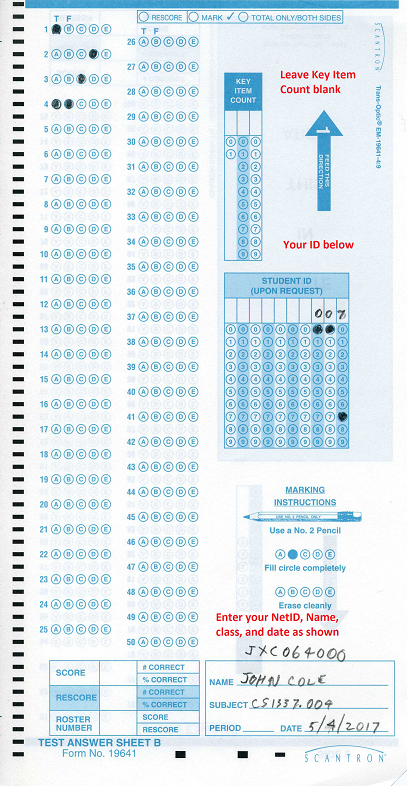
of a technique that will save you time and give you good results. ScanTron form, correctly filled out. (Only
for tests in the classroom.)
The entire form, including your name and course, must be done in number 2 pencil only. Pen
does not scan and you will lose 10 points for any corrections I must make to
your form, including using the wrong one, using pen, etc. The "ID" field is a number that will be assigned to you as a "grade" in eLearning.
Ideally, you should have filled in the information other than the answers (I
have shown a few sample answers, but ignore those) before you come to class. Grader Guidelines
for graders to follow and students to understand.
You will find assignments, grades, and other class material on
eLearning, also called Blackboard.
The Computer Science Department main page contains recent events and other information. It's also pretty cool. UTD International Student Services
Organization. Given the importance of writing in most of my classes,
if English is not your first language you will find useful events, such as
conversation workshops, writing help, and other help here. You can also get
writing help from the
Student
Success Center's Writing Center. I cannot stress enough the importance
of good writing. The Computer Science Mentor Center can help you with CS1336, CS1337,
CS2340, and CS2336,
among other classes.
Click here to go to the Center's
official page. Many books and journals that are
useful in my classes are online at
the UTD Library.
Suggested Reading.A few
of you have asked for this list so you don't have to write things down when I
reference them in class.
*The 90s called and asked for their Web site back, but they can't have
it. I'm using it, and it's easy to maintain and contains far more
useful information than you will find on most professors' sites.