|
Xiaohu
Guo's Research |
|
RESEARCH INTERESTS |
|
| |
Generally,
I am interested mainly on geometric aspects related to Computer Graphics,
like Geometric Modeling, Processing, and Physics-Based Modeling,
Computer Animaiton, Medical Image Analysis, etc.
Specifically,
my previous PhD thesis researches are mainly focused on the point-based
modeling and meshless simulation. My current researches at UT-Dallas
includes: mesh generation, centroidal Voronoi tessellation, spectral geometric analysis, deformable
models, compression, watermarking, GPU-based algorithms,
and medical image registration, etc. |
| |
|
| RESEARCH
PROJECTS |
|
| |
 |
- Particle-Based Anisotropic Surface Meshing
|
We introduce a particle-based approach for anisotropic surface meshing. Given an input polygonal mesh endowed with a Riemannian metric and a specified number of vertices, the method generates a metric-adapted mesh. The main idea consists of mapping the anisotropic space into a higher dimensional isotropic one, called “embedding space”. The vertices of the mesh are generated by uniformly sampling the surface in this higher dimensional embedding space, and the sampling is further regularized by optimizing an energy function with a quasi-Newton algorithm. All the computation can be re-expressed in terms of the dot product in the embedding space, and the Jacobian matrices of the mappings that connect different spaces. This transform makes it unnecessary to explicitly represent the coordinates in the embedding space, and also provides all necessary expressions of energy and forces for efficient computations. Through energy optimization, it naturally leads to the desired anisotropic particle distributions in the original space...
- Zichun Zhong, Xiaohu Guo, Wenping Wang, Bruno Lévy, Feng Sun, Yang Liu, Weihua Mao, "Particle-Based Anisotropic Surface Meshing," in ACM Transactions on Graphics (Proceedings of SIGGRAPH 2013), Vol. 32, Issue 4, Article No. 99, 2013. [paper][appendix][UTD news]
|
|
 |
- Boundary-Aware Multi-Domain Subspace Deformation
|
We propose a novel framework for multi-domain subspace deformation using node-wise corotational elasticity. With the proper construction of subspaces based on the knowledge of the boundary deformation, we can use the Lagrange multiplier technique to impose coupling constraints at the boundary without over-constraining. In our deformation algorithm, the number of constraint equations to couple two neighboring domains is not related to the number of the nodes on the boundary but is the same as the number of the selected boundary deformation modes. The crack artifact is not present in our simulation result and the domain decomposition with loops can be easily handled....
- Yin Yang, Weiwei Xu, Xiaohu Guo, Kun Zhou, Baining Guo, "Boundary-Aware Multi-Domain Subspace Deformation," in IEEE Transactions on Visualization and Computer Graphics, Vol. 19, No. 10, pp. 1633-1645, 2013. [paper][video]
|
|
 |
|
A physics-based framework is presented to visualize the human tongue deformation. The tongue is modeled with the finite element method (FEM) and driven by the motion capture data gathered during speech production. Several novel deformation visualization techniques are presented for in-depth data analysis and exploration. To reveal the hidden semantic information of the tongue deformation, we present a novel physics-based volume segmentation algorithm. This is accomplished by decomposing the tongue model into segments based on its deformation pattern with the computation of deformation subspaces and fitting the target deformation locally at each segment. In addition, the strain energy is utilized to provide an intuitive low dimensional visualization for the high dimensional sequential motion. Energy-interpolation-based morphing is also equipped to effectively highlight the subtle differences of the 3D deformed shapes without any visual occlusion...
- Yin Yang, Xiaohu Guo, Jennell Vick, Luis Torres, Thomas Campbell, "Physics-Based Deformable Tongue Visualization," in IEEE Transactions on Visualization and Computer Graphics, Vol. 19, No. 5, pp. 811-823, 2013. [paper][video]
|
|
|
|
We
extend the concept of the CVT from Euclidean and spherical space to
hyperbolic space. A novel hyperbolic CVT energy is defined,
and the relationship between minimizing this energy and
the hyperbolic CVT is proved. Two algorithms -- Lloyd's
algorithm and the L-BFGS algorithm -- are adopted to compute
the hyperbolic CVT, and the convergence of Lloyd's algorithm
is proved. After conformally mapping the surfaces onto their universal covering space, the periodic CVT is computed on either Euclidean and hyperbolic spaces for surfaces with genus>=1. We utilize the periodic CVT to compute uniform
partitions and high-quality remeshing results for surfaces of arbitrary topology...
- Liang
Shuai,
Xiaohu Guo, Miao Jin, "GPU-Based Computation of
Discrete Periodic Centroidal Voronoi Tessellation in
Hyperbolic Space," in Computer-Aided
Design (SPM 2012 Special Issue), Vol. 45, No. 2, pp. 463-472, 2013. [paper][web]
- Guodong
Rong, Miao Jin, Liang Shuai, Xiaohu Guo, "Centroidal
Voronoi Tessellation in Universal Covering Space of
Manifold Surfaces," in Computer Aided Geometric
Design, Vol. 28, No. 8, pp. 475-496, 2011. [paper][web]
- Guodong
Rong, Miao Jin, Xiaohu Guo, "Hyperbolic Centroidal
Voronoi Tessellation," in Proceedings of ACM Symposium
on Solid and Physical Modeling (SPM 2010), pp. 117-126,
Haifa, Israel, September 2010. [paper][errata][web]
|
|
 |
|
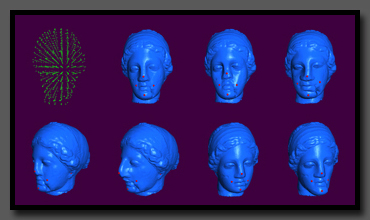
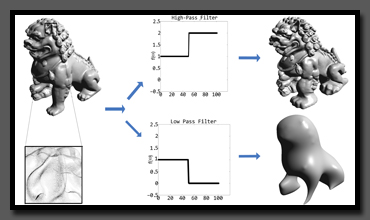
We
propose an algorithm to build a set of orthogonal Point-Based
Manifold Harmonic Bases (PB-MHB) for spectral analysis
over point-sampled manifold surfaces. To ensure that PB-MHB
are orthogonal to each other, it is necessary to have
symmetrizable discrete Laplace-Beltrami Operator (LBO) over
the surfaces. Existing converging discrete LBO proposed
by Belkin et al is not guaranteed to be symmetrizable. We
build a new point-wisely discrete LBO over the point-sampled
surface that is guaranteed to be symmetrizable, and prove
its convergence...
- Yang
Liu, Balakrishnan Prabhakaran, Xiaohu Guo, "Point-Based
Manifold Harmonics," in IEEE Transactions on Visualization and Computer Graphics, Vol. 18, No. 10, pp. 1693-1703, 2012. [paper][video][source code][web]
|
|
|
|
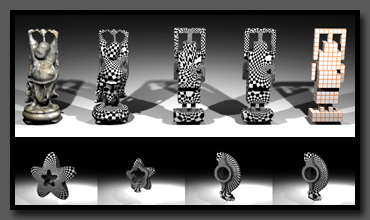
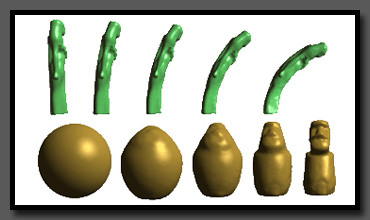
Centroidal
Voronoi tessellation (CVT) is widely used in computational
science and engineering. The most commonly used method
is Lloyd's method, and recently Liu et al propose the
L-BFGS method for computing CVT and show that it is faster
than Lloyd's method. These methods run on the CPU and
are still too slow for many practical applications. We
present new techniques to implement these two methods
on the GPU for computing CVT on a 2D plane and on a surface,
and demonstrate significant speedup of these GPU-based
methods over their CPU counterparts...
- Guodong
Rong,
Yang Liu, Wenping Wang, Xiaotian Yin, Xianfeng Gu, Xiaohu
Guo, "GPU-Assisted Computation of Centroidal Voronoi
Tessellation," in IEEE Transactions on Visualization
and Computer Graphics, Vol. 17, No. 3, pp. 345-356,
2011. [paper][video][source code]
|
|
|
|
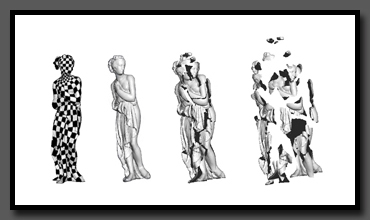
In
this paper we describe a spectral method to compress the
geometric shapes equipped with arbitrary valid parametric
information. It guarantees to preserve user-specified
feature lines while achieving a high compression ratio.
By applying the spectral shape analysis -- Dirichlet Manifold
Harmonics, in the 2D parametric domain, this method provides
a progressive compression mechanism to trade-off between
bit-rate and shape quality...
- Yang
Liu, Balakrishnan Prabhakaran, Xiaohu Guo, "Dirichlet
Harmonic Shape Compression with Feature Preservation
for Parameterized Surfaces," in Computer Graphics
Forum (PG 2010 Special Issue), Vol. 29, No. 7, pp. 2039-2048,
2010. [paper][video]
|
|
|
|
A
novel spectral framework is proposed to simulate a hybrid
body with both deformable and rigid regions in real-time.
We extend the modal analysis technique to rigid body simulation
while using the modal warping method to handle rotational
deformation in the deformable subsystem, and thus build
up a uniform physically based spectral solution for the
hybrid system. Moreover, a new strategy that fortifies
the connection constraint between subsystems is employed
to replace the traditional position constraint expression
which accumulates the approximation errors making the
whole system unstable...
- Yin
Yang, Guodong Rong, Luis Torres, Xiaohu Guo, "Real-Time
Hybrid Solid Simulation: Spectral Unification of Deformable
and Rigid Materials," in Computer Animation and
Virtual Worlds (CASA 2010 Special Issue), Vol. 21, No.
3-4, pp. 151-159, 2010. [paper][video]
|
|
|
|
Streaming
deformations on complex 3D objects arising from a user¡¯s
manipulations is a challenging task. In this research,
we propose a framework for real-time streaming of 3D deformations
in collaborative learning applications. Our research contributions
through this framework include: (i) use of spectrumbased
surface deformation for real-time, distributed computation
of the 3D model; (ii) handling different clients display
capabilities by enabling the deformations to be applied
on multiple resolutions of the same 3D object. Our experiments
indicate that transmission of deformation information
can be accomplished in a very short time, even for large
and complicated 3D models...
- Ziying
Tang, Guodong Rong,
Xiaohu Guo, Balakrishnan Prabhakaran, "Streaming
3D Shape Deformations in Collaborative Virtual Environment,"
in Proceedings of IEEE Virtual Reality Conference (VR
2010), pp. 183-186, Waltham, Massachusetts, March 2010.
[paper][video]
- Ziying
Tang, Orkun Ozbek,
Xiaohu Guo, "Real-Time 3D Interaction with Deformable Model on Mobile Devices," to appear
in Proceedings of ACM Multimedia Conference (MM
2011), Scottsdale, AZ, November 2011.
|
|
|
|
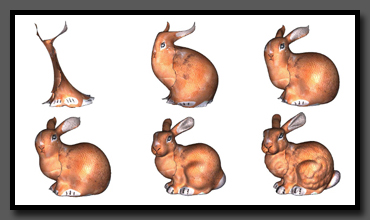
The
geometry and motion of the original irregular meshes can
be compactly encoded using the low-frequency spectrum
of the manifold surfaces. Using the spectral method, the
size of the linear/nonlinear deformation system can be
significantly reduced to achieve interactive computational
speed for manipulating large triangle meshes...
- Guodong
Rong,
Yan Cao, Xiaohu Guo, "Spectral Mesh Deformation,"
in The Visual Computer (CGI2008 Special Issue), Vol.
24, No. 7-9, pp. 787-796, 2008. [paper][video][web]
- Guodong
Rong,
Yan Cao, Xiaohu Guo, "Spectral Surface Deformation
with Dual Mesh," in Proceedings of the 21st International
Conference on Computer Animation and Social Agents (CASA2008),
pp. 17-24, Seoul, Korea, September 2008. [paper][video][web]
|
|
|
|
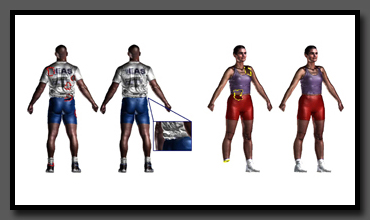
We
propose a blind and imperceptible spectral watermarking
approach for manifold surfaces represented as triangle
meshes. The basic idea is to transform the original mesh
into frequency domain using the Fourier-Like Manifold
Harmonics Transform. The manifold harmonics basis defined
on arbitrary topology surfaces is an intrinsic property
of the manifold surfaces, which makes our watermarking
scheme immune to uniform affine attack (rotation, scaling,
and translation) and robust against noise-addition and
mesh simplification attacks...
- Yang
Liu, Balakrishnan Prabhakaran, Xiaohu Guo, "A Robust
Spectral Approach for Blind Watermarking of Manifold
Surfaces," in Proceedings of ACM Multimedia &
Security Workshop, pp. 43-52, Oxford, UK, September
2008. [paper]
- Yang
Liu, Balakrishnan Prabhakaran, Xiaohu Guo, "Blind
Invisible Watermarking for 3D Meshes with Textures,"
in Proceedings of IEEE International Conference on Image
Processing, pp. 3689-3692, Hong Kong, September 2010.
[paper]
- Yang
Liu, Balakrishnan Prabhakaran, Xiaohu Guo, "Spectral Watermarking for Parameterized Surfaces,"
in IEEE Transactions on Information Forensics and Security, Vol. 7, No. 5, pp. 1459-1471, 2012. [paper]
|
|
|
|
Harmonic
volumetric mapping for two solid objects establishes a
one-to-one smooth correspondence between them. It finds
its applications in shape registration and analysis, shape
retrieval, information reuse, and material/texture transplant...
- Xin
Li, Xiaohu Guo, Hongyu Wang, Ying He, Xianfeng Gu, Hong
Qin, "Harmonic Volumetric Mapping for Solid Modeling
Applications," in Proceedings of ACM Symposium
on Solid and Physical Modeling (SPM 2007), pp. 109 -
120, Beijing, June 2007. [paper]
- Xin
Li, Xiaohu Guo, Hongyu Wang, Ying He, Xianfeng Gu, Hong
Qin, "Meshless Harmonic Volumetric Mapping using
Fundamental Solution Methods," in IEEE Transactions
on Automation Science and Engineering, Vol. 6, No. 3,
pp. 409-422, 2009. [paper]
|
|
| |
|
We
developed a quasi-conformal surface mapping paradigm which
minimizes angle distortion and metric distortion of mappings
globally based on the intrinsic geometric structure of
surfaces...
- Xin
Li, Yunfan Bao, Xiaohu Guo, Miao Jin, Xianfeng Gu, Hong
Qin, "Globally Optimal Surface Mapping for Surfaces
with Arbitrary Topology," in IEEE Transactions on
Visualization and Computer Graphics, Vol. 14, No. 4,
pp. 805-819, 2008. [paper][video]
|
|
| |
|
We
developed a new paradigm which elegantly integrates the
thin-shell finite-element simulation with geometric design
of arbitrary manifold spline surfaces...
- Kexiang
Wang, Ying He, Xiaohu Guo, Xianfeng Gu, Hong Qin, "Spline
Thin-Shell Simulation of Manifold Surfaces," in
Proceedings of Computer Graphics International (Lecture
Notes in Computer Science, Springer, Vol. 4035, pp.
570-577), 2006. [paper]
|
|
| |
|
A
new approach for the meshless thin-shell elastic deformation
and fracture simulation of point-sampled geometry via
explicit, global conformal point-surface parameterization...
-
Xiaohu
Guo, Xin Li, Yunfan Bao, Xianfeng Gu, Hong Qin, "Meshless
Thin-shell Simulation Based on Global Conformal Parameterization,"
in IEEE Transactions on Visualization and Computer
Graphics (TVCG), Vol. 12, No. 3, pp. 375-385, 2006.
[paper][video][web]
|
|
| |
|
A
new surface content completion framework that can restore
both shape and appearance (texture) from scaned, incomplete
point set inputs...
-
Seyoun
Park, Xiaohu Guo, Hayong Shin, Hong Qin, "Shape
and Appearance Repair for Incomplete Point Surfaces,"
in Proceedings of the 10th IEEE International Conference
on Computer Vision (ICCV 2005), pp. 1260 - 1267, Beijing,
October, 2005. [paper][video][web]
- Seyoun
Park, Xiaohu Guo, Hayong Shin, Hong Qin, "Surface
Completion for Shape and Appearance," in The Visual
Computer, Vol. 22, No. 3, pp. 168 - 180, 2006. [paper][video][web]
|
|
| |
- Physically-Based
Morphing of Point-Sampled Surfaces
|
An
innovative method for naturally and smoothly morphing
two point-sampled surfaces via dynamic, meshless simulation...
- Yunfan
Bao, Xiaohu Guo, Hong Qin, "Physically Based Morphing
of Point-sampled Surfaces," in the 18th International
Conference on Computer Animation and Social Agents (CASA
2005), Hong Kong, October, 2005. One of the best papers
invited to the journal of Computer Animation and Virtual
Worlds, Vol. 16, No. 3-4, pp. 509 - 518, 2005.
[paper][video][slides][web]
|
|
| |
- Real-Time
Meshless Deformation
|
A
real-time meshless simulation paradigm for point-sampled
solid objects using Modal Warping technique...
- Xiaohu
Guo, Hong Qin, "Real-time Meshless Deformation,"
in the 18th International Conference on Computer Animation
and Social Agents (CASA 2005), Hong Kong, October, 2005.
One of the best papers invited to the journal of Computer
Animation and Virtual Worlds, Vol. 16, No.
3-4, pp. 189 - 200, 2005. [paper][video][slides][web]
|
|
|
|
|
A
modeling paradigm and system for local and global editing
on point set surfaces lets users easily modify the topology
of sculpted point sets...
- Xiaohu
Guo, Jing Hua, and Hong Qin, "Point Set Surface
Editing Techniques based on Level-Sets," in Computer
Graphics International '04, pp. 52 - 59, Crete, Greece,
June 2004. [paper][slides][web]
- Xiaohu
Guo, Jing Hua, and Hong Qin, "Scalar-Function-Driven
Editing on Point Set Surfaces," in IEEE
Computer Graphics and Applications, Vol. 24, No. 4,
pp. 43 - 52, 2004. [paper][web]
|
|
|
|
A
modeling paradigm for haptics-based editing on point set
surfaces exploits implicit surfaces, physics-based modeling,
point-sampled surfaces, and haptic feedback...
- Xiaohu
Guo and Hong Qin, "Dynamic Sculpting and Deformation
of Point Set Surfaces," in Pacific Graphics' 03,
pp. 123 - 130, Canmore, Alberta, Canada, October 2003.
[paper][slides][web]
- Xiaohu
Guo, Jing Hua, and Hong Qin, "Touch-Based Haptics
for Interactive Editing on Point Set Surfaces,"
in IEEE Computer Graphics and Applications, Vol. 24,
No. 6, pp. 31 - 39, 2004. [paper][web]
|
|
| |
| |
| More are
coming... |
|